The brief
Give a machining buyer enough visual specificity to ask a useful question: who operates the machine, what feature is being cut, and how does the intended path relate to the part?
Scene sequence and accessible transcript
0:00–0:06 — An operator works beside an industrial lathe. On-screen: “A part begins with a path.”. Spoken: “Every precise part starts with a clear requirement.”
0:06–0:12 — A lathe tool cuts a turning cylinder. On-screen: “Meet the cutting edge.”. Spoken: “The cutting edge turns shape into a real surface.”
0:12–0:18 — An original turning diagram reveals the moving tool and stepped profile. On-screen: “Trace the intended feature.”. Spoken: “One feature. One deliberate path.”
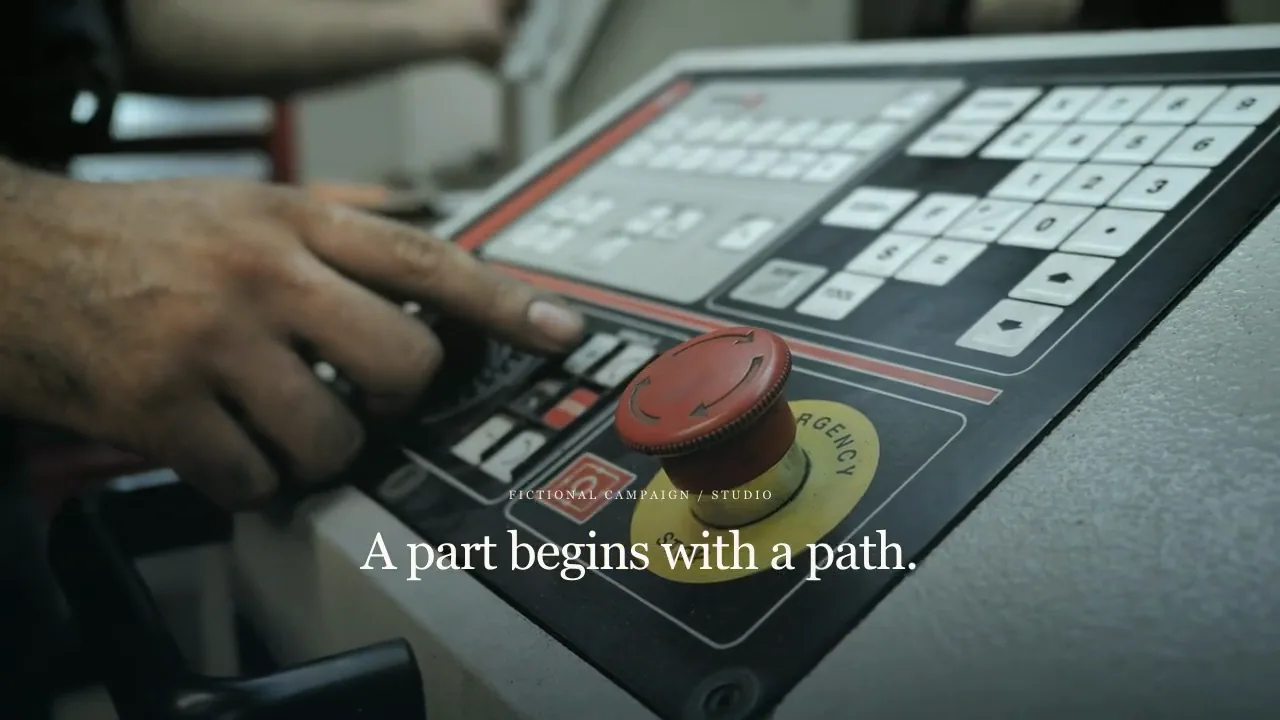
0:18–0:24 — A cutting machine and its control panel operate. On-screen: “Bring the part requirements.”. Spoken: “Bring the drawing. Start the conversation.”
What the film does and does not establish
The toolpath is an original simplified schematic, not executable G-code or a validated manufacturing program. Stock footage does not establish a specific machine model, material grade, tolerance, or achieved finish.
Keep the business information reviewable
Keep drawing revision, material designation, feature names, and approved dimensions as reviewed editable facts. Change the illustrative path only when the explanation and source drawing change together.
Production and source
This is a complete authored studio film with four independently sequenced scenes, original narration, a film-specific score, and captions. The film is a fictional campaign concept rather than a customer case or a Martius product execution recording.
Real stock shots and original simplified illustrations are explicitly distinguished. Raw source footage stays in private production directories; only the edited film, poster, and captions are published.
Words, sound and scene notes
- 00:00
- Every precise part starts with a clear requirement. [Visual: An operator works beside an industrial lathe. Original instrumental score.]
- 00:06
- The cutting edge turns shape into a real surface. [Visual: A lathe tool cuts a turning cylinder. Original instrumental score.]
- 00:12
- One feature. One deliberate path. [Visual: An original turning diagram reveals the moving tool and stepped profile. Original instrumental score.]
- 00:18
- Bring the drawing. Start the conversation. [Visual: A cutting machine and its control panel operate. Original instrumental score.]