The brief
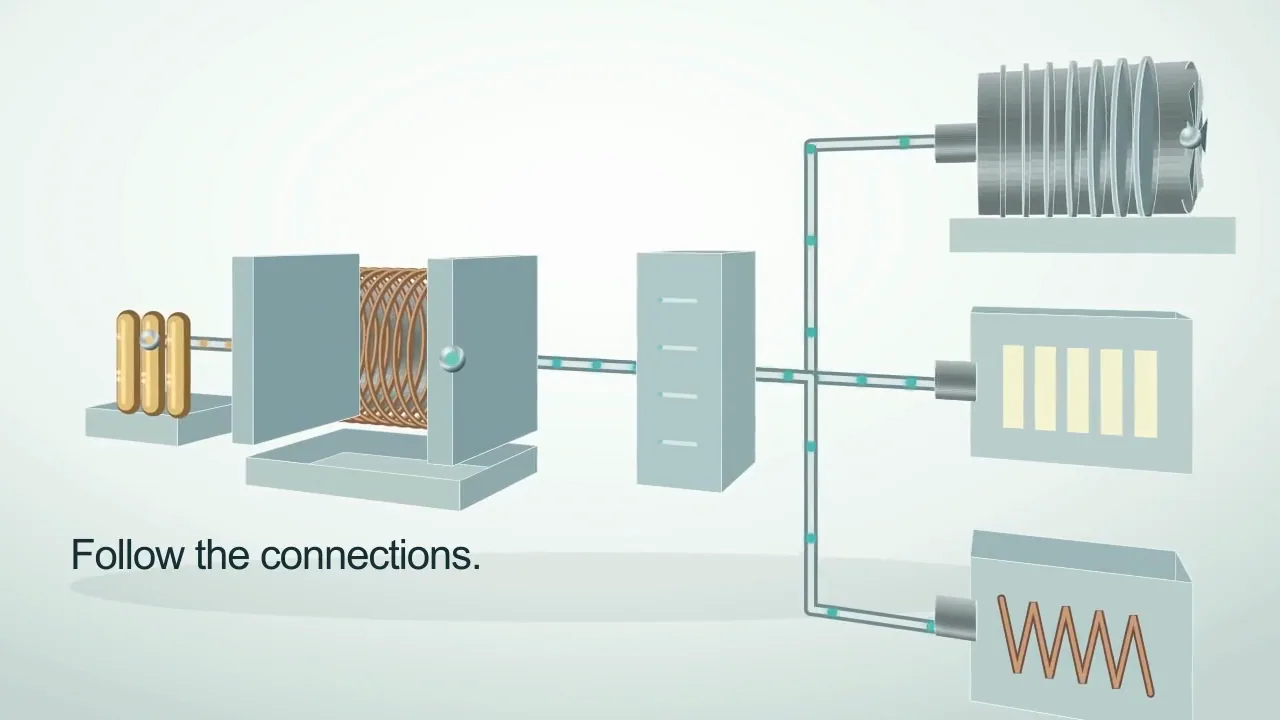
Use six seconds of generic industrial context, then move into eighteen seconds of independent original energy-system motion. Travel from warm input markers and a conversion-inspired structure through a distribution hub to motor, lighting and heat-inspired loads, so each role has a visible place in the system.
Audience: training teams, technical reviewers and process owners creating a concise industrial energy systems and end uses film.
The visual approach
00–06s: Generic industrial towers and pipes establish scale; the installation’s purpose is not identified. 06–12s: The film enters an independent original dimensional model: warm input markers approach a metal-and-copper conversion-inspired structure. 12–18s: The original camera widens toward a metal-like hub and clearly connected branching routes with flowing cool markers. 18–24s: The original camera moves toward three different end-use forms: a rotating motor-inspired unit, luminous lighting elements and a heat-inspired coil.
The ambient composition uses a 88 BPM rhythm selected for this storyboard. On-screen words stay short so the industrial energy systems and end uses imagery carries the sequence.
Review and editable scope
A real production brief would keep the industrial energy systems and end uses subject, source attribution, exact narration and caption wording available for review. A subject specialist must approve the factual explanation before using it in a real lesson.
The studio production plan keeps the four shot selections, crop, title, narration, captions and sound design separate. These notes document how this authored film was made. Use the Martius feature documentation for the product editing and review workflow.
Sources and interpretation
The opening stock shot depicts generic towers, pipes and industrial structures whose facility function and operating state are unknown; it is not identified as a power station or grid. All connected equipment that follows is independent original conceptual motion design, not a real installation, electrical schematic, generator cutaway, engineered conversion device or measured energy simulation. Geometry, connections, colors, timing and flowing markers are illustrative, without voltage, efficiency, capacity, safety or performance claims. No switching, isolation, maintenance, fault diagnosis or operating procedure is supplied.
The linked U.S. Energy Information Administration: electricity generation resource supports the conceptual topic. Stock subjects are illustrative and are not Martius customers, endorsements or evidence of a named facility’s practices. Original illustration is marked as conceptual wherever its appearance could be confused with observed data.
Scene-by-scene transcript
00–06s — Generic industrial towers and pipes establish scale; the installation’s purpose is not identified. On-screen text: Begin with the roles.. Narration: Industrial systems connect equipment through distinct energy roles. Original stereo score.
06–12s — The film enters an independent original dimensional model: warm input markers approach a metal-and-copper conversion-inspired structure. On-screen text: An input changes form.. Narration: Energy conversion changes an input into a useful form. Original stereo score.
12–18s — The original camera widens toward a metal-like hub and clearly connected branching routes with flowing cool markers. On-screen text: Follow the connections.. Narration: Distribution links the supply to the loads that use it. Original stereo score.
18–24s — The original camera moves toward three different end-use forms: a rotating motor-inspired unit, luminous lighting elements and a heat-inspired coil. On-screen text: Different end uses.. Narration: Loads use energy for motion, lighting and heat. Original stereo score.
Words, sound and scene notes
- 00:00
- Generic industrial towers and pipes establish scale; the installation’s purpose is not identified. On-screen text: Begin with the roles.. Narration: Industrial systems connect equipment through distinct energy roles. Original stereo score.
- 00:06
- The film enters an independent original dimensional model: warm input markers approach a metal-and-copper conversion-inspired structure. On-screen text: An input changes form.. Narration: Energy conversion changes an input into a useful form. Original stereo score.
- 00:12
- The original camera widens toward a metal-like hub and clearly connected branching routes with flowing cool markers. On-screen text: Follow the connections.. Narration: Distribution links the supply to the loads that use it. Original stereo score.
- 00:18
- The original camera moves toward three different end-use forms: a rotating motor-inspired unit, luminous lighting elements and a heat-inspired coil. On-screen text: Different end uses.. Narration: Loads use energy for motion, lighting and heat. Original stereo score.