The brief
Make it clear why an inspection explanation needs both something to observe and a defined question. The original scanning sweep highlights a fictional feature rather than displaying an invented analytics dashboard.
Scene sequence and accessible transcript
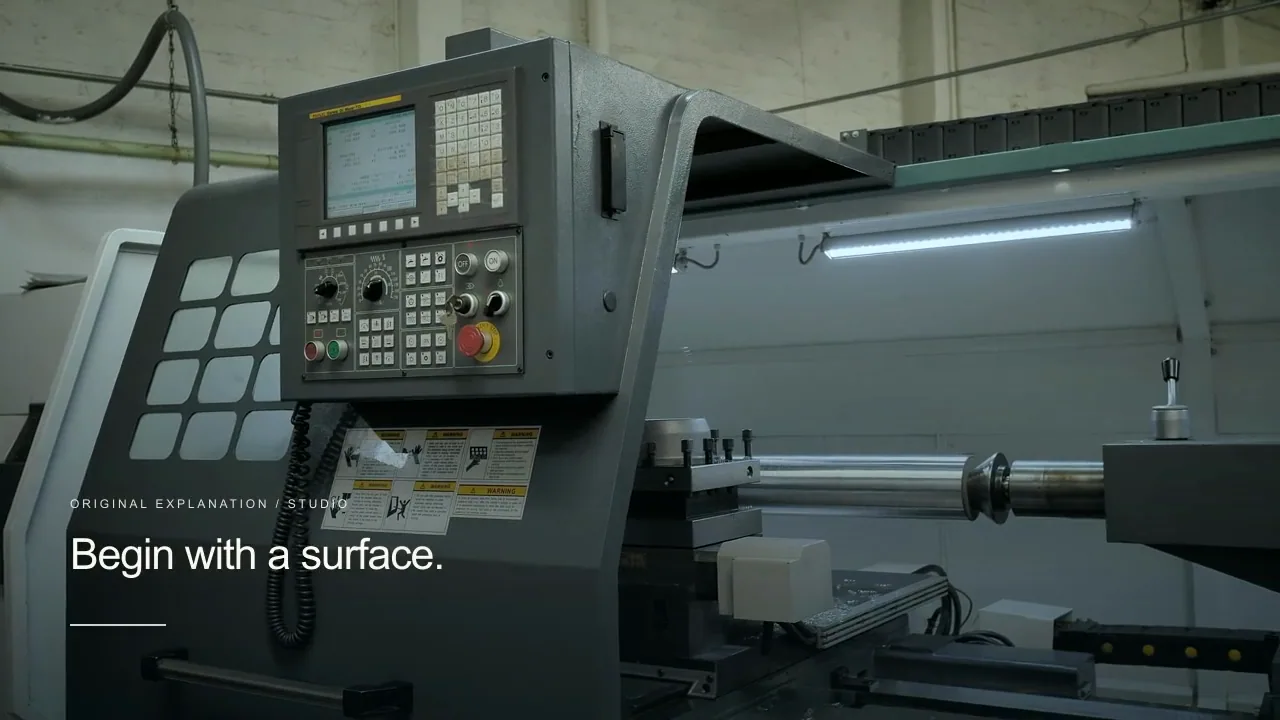
0:00–0:06 — Real industrial cutting provides a visible material surface. On-screen: “Begin with a surface.”. Spoken: “An inspection starts with a defined feature on a part.”
0:06–0:12 — A scanning band crosses a metallic component and illuminates a fictional flaw. On-screen: “Light makes a feature visible.”. Spoken: “Light makes a surface feature easier to observe.”
0:12–0:18 — A scientist prepares a sample in a laboratory. On-screen: “A sample needs a question.”. Spoken: “A sample and a criterion answer different questions.”
0:18–0:24 — The illustrative surface feature remains highlighted beneath the scanning band. On-screen: “A mark is not a decision.”. Spoken: “An observed mark still needs an acceptance rule.”
What the film does and does not establish
The scan is a conceptual visualization, not footage from a vision system. It omits optics, calibration, algorithms, lighting design, resolution, actual measurements, and decision thresholds.
Keep the business information reviewable
Review the real feature, illumination conditions, image framing, and acceptance rule together. If any changes, the highlighted region, explanation, and captions must be revised.
Production and source
This is a complete authored studio film with four independently sequenced scenes, original narration, a film-specific score, and captions. The film is a fictional campaign concept rather than a customer case or a Martius product execution recording.
Real stock shots and original simplified illustrations are explicitly distinguished. Raw source footage stays in private production directories; only the edited film, poster, and captions are published.
Words, sound and scene notes
- 00:00
- An inspection starts with a defined feature on a part. [Visual: Real industrial cutting provides a visible material surface. Original instrumental score.]
- 00:06
- Light makes a surface feature easier to observe. [Visual: A scanning band crosses a metallic component and illuminates a fictional flaw. Original instrumental score.]
- 00:12
- A sample and a criterion answer different questions. [Visual: A scientist prepares a sample in a laboratory. Original instrumental score.]
- 00:18
- An observed mark still needs an acceptance rule. [Visual: The illustrative surface feature remains highlighted beneath the scanning band. Original instrumental score.]