The brief
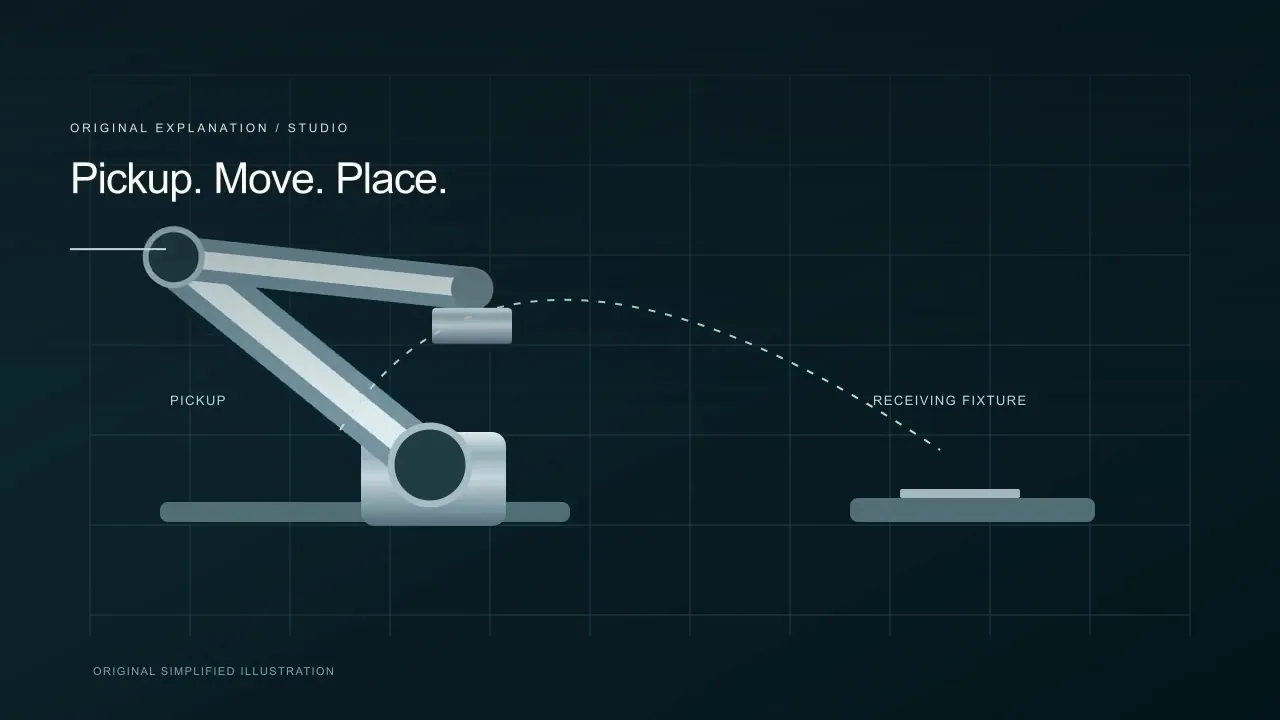
Separate the robot as a physical machine from the task it is intended to perform. A single workpiece and receiving fixture give the movement an understandable beginning and end.
Scene sequence and accessible transcript
0:00–0:06 — The original arm begins a conceptual pickup and transfer. On-screen: “Pickup. Move. Place.”. Spoken: “A transfer has three parts: pickup, movement, and placement.”
0:06–0:12 — The original arm continues toward the receiving fixture. On-screen: “Pickup. Move. Place.”. Spoken: “The workpiece travels toward a receiving fixture.”
0:12–0:18 — Real CNC tooling represents a different manufacturing operation. On-screen: “A different task in the chain.”. Spoken: “Machining is a different task in the wider production chain.”
0:18–0:24 — The original part remains positioned at its receiving fixture. On-screen: “The fixture gives it meaning.”. Spoken: “The fixture gives this illustrated transfer its destination.”
What the film does and does not establish
The animation is not a real robot program or validated cell layout. It omits kinematics, collision clearance, guarding, emergency stops, controller logic, tool loads, and safety procedures.
Keep the business information reviewable
Review task names, part orientation, fixture location, and the illustrated movement when the real cell changes. Preserve the distinction between an explanatory path and executable control.
Production and source
This is a complete authored studio film with four independently sequenced scenes, original narration, a film-specific score, and captions. The film is a fictional campaign concept rather than a customer case or a Martius product execution recording.
Real stock shots and original simplified illustrations are explicitly distinguished. Raw source footage stays in private production directories; only the edited film, poster, and captions are published.
Words, sound and scene notes
- 00:00
- A transfer has three parts: pickup, movement, and placement. [Visual: The original arm begins a conceptual pickup and transfer. Original instrumental score.]
- 00:06
- The workpiece travels toward a receiving fixture. [Visual: The original arm continues toward the receiving fixture. Original instrumental score.]
- 00:12
- Machining is a different task in the wider production chain. [Visual: Real CNC tooling represents a different manufacturing operation. Original instrumental score.]
- 00:18
- The fixture gives this illustrated transfer its destination. [Visual: The original part remains positioned at its receiving fixture. Original instrumental score.]