The brief
Follow one illustrative workpiece from pickup through a lifted transfer to a fixture. Use the changing shoulder, elbow and gripper relationships to make the difference between a joint movement and a complete task visible.
Audience: educators, technical communicators and subject specialists creating a concise manufacturing robotics and coordinated motion film.
The visual approach
00–06s: An original orange articulated arm holds a fictional component above the pickup tray. 06–12s: The dimensional shoulder and elbow change angle as the gripper rises from the tray. 12–18s: The original metal-like component travels over the work area while the arm extends. 18–24s: The gripper settles at the receiving fixture and opens, leaving the illustrative component in place.
The mechanical composition uses a 110 BPM rhythm selected for this storyboard. On-screen words stay short so the manufacturing robotics and coordinated motion imagery carries the sequence.
Review and editable scope
A real production brief would keep the manufacturing robotics and coordinated motion subject, source attribution, exact narration and caption wording available for review. A subject specialist must approve the factual explanation before using it in a real lesson.
The studio production plan keeps the four shot selections, crop, title, narration, captions and sound design separate. These notes document how this authored film was made. Use the Martius feature documentation for the product editing and review workflow.
Sources and interpretation
The orange articulated arm, metal-like surfaces, gripper and workpiece are independent original motion design. They illustrate coordinated motion, not a real robot, measured kinematics, controller program, validated trajectory or safety assessment. The rendered geometry and movement are simplified; no positioning accuracy, cycle time, payload or named manufacturer is claimed.
The linked NIST: manufacturing robotics resource supports the conceptual topic. Stock subjects are illustrative and are not Martius customers, endorsements or evidence of a named facility’s practices. Original illustration is marked as conceptual wherever its appearance could be confused with observed data.
Scene-by-scene transcript
00–06s — An original orange articulated arm holds a fictional component above the pickup tray. On-screen text: Pickup to destination.. Narration: A robotic task connects pickup with a destination. Original stereo score.
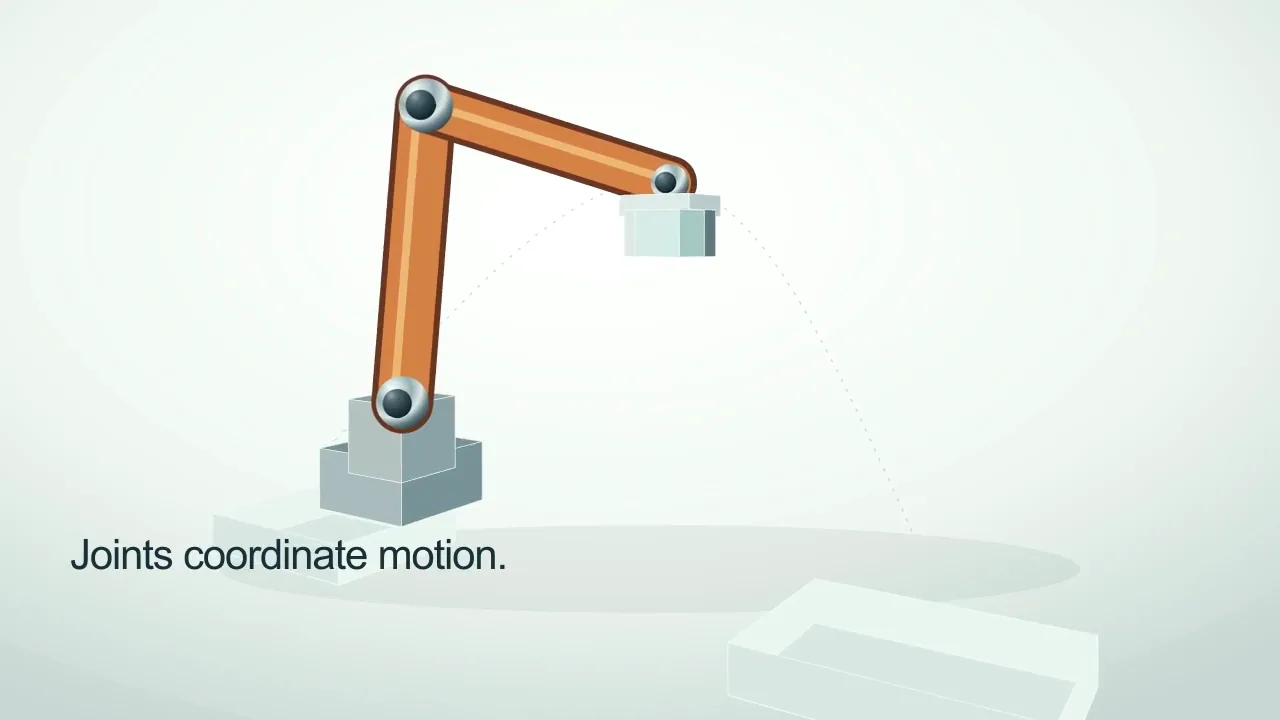
06–12s — The dimensional shoulder and elbow change angle as the gripper rises from the tray. On-screen text: Joints coordinate motion.. Narration: Coordinated joints move the carried component through space. Original stereo score.
12–18s — The original metal-like component travels over the work area while the arm extends. On-screen text: Motion serves a purpose.. Narration: The gripper carries the part toward its receiving fixture. Original stereo score.
18–24s — The gripper settles at the receiving fixture and opens, leaving the illustrative component in place. On-screen text: Arrive. Release. Complete.. Narration: Arrival and release belong to the complete task. Original stereo score.
Words, sound and scene notes
- 00:00
- An original orange articulated arm holds a fictional component above the pickup tray. On-screen text: Pickup to destination.. Narration: A robotic task connects pickup with a destination. Original stereo score.
- 00:06
- The dimensional shoulder and elbow change angle as the gripper rises from the tray. On-screen text: Joints coordinate motion.. Narration: Coordinated joints move the carried component through space. Original stereo score.
- 00:12
- The original metal-like component travels over the work area while the arm extends. On-screen text: Motion serves a purpose.. Narration: The gripper carries the part toward its receiving fixture. Original stereo score.
- 00:18
- The gripper settles at the receiving fixture and opens, leaving the illustrative component in place. On-screen text: Arrive. Release. Complete.. Narration: Arrival and release belong to the complete task. Original stereo score.