The brief
Answer one question: how does light at the panel become electricity a home can use? Real footage establishes the system, then a diagram makes an otherwise invisible relationship visible.
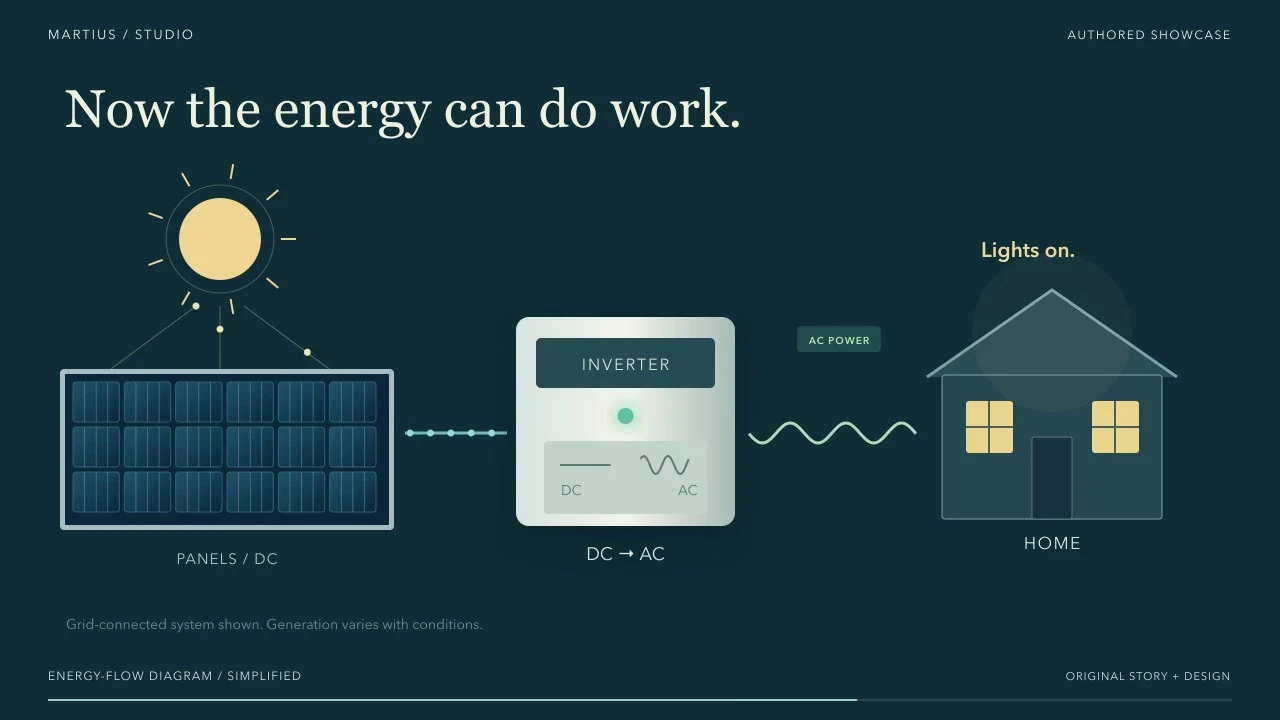
The film shows a simplified flow of energy in a grid-connected photovoltaic system. Particle size, speed, and waveform movement are explanatory graphics. It omits installation design, storage controls, protection equipment, and detailed grid behavior; no efficiency, generation, savings, or outage-backup result is promised.
Scene sequence and accessible transcript
0:00–0:05 — Real solar-cell footage introduces “From light to living.” The narration asks how sunlight becomes power at home.
0:05–0:11 — Light particles reach photovoltaic cells; a moving DC stream travels toward the inverter.
0:11–0:18 — A close inverter view contrasts the straight DC stream with an animated AC waveform.
0:18–0:25 — The whole energy path appears. The home windows illuminate after 0:19.2; a conditional branch appears after 0:22 with “Excess may flow to the grid.” The screen identifies a grid-connected system and says generation varies with conditions.
0:25–0:30 — Real rooftop footage returns beneath the complete SUNLIGHT → PANEL / DC → INVERTER → HOME / AC sequence. The English caption file contains the spoken explanation.
Why this treatment works
Footage answers “what does the system look like?” The moving diagram answers “how are the parts related?” A close-up of the conversion is the moment that connects those questions.
Review the direction of every arrow and align narration with the visual state. A beautiful diagram still needs a subject specialist to verify its meaning.
Production and source
An authored showcase produced for this website, not output from the Martius Agent or a customer campaign.
Stock footage is by Laurin Berli and Kindel Media on Pexels. The film’s diagram, edit, original script, synthetic narration, and soundtrack were authored for this website.
Words, sound and scene notes
- 00:00
- How does sunlight become power at home? Follow the energy.
- 00:05
- Photovoltaic cells absorb light energy and create a direct current.
- 00:11
- The inverter converts that direct current into alternating current, the kind household appliances use.
- 00:18
- That power can run the home. In a grid-connected system, excess electricity may flow to the grid.
- 00:25
- From sunlight to electricity at home. One continuous journey.