The brief
Show one relationship: material rotates, a cutting tool moves relative to it, and the surface changes. Make the profile visible without substituting a schematic for a machine program.
Scene sequence and accessible transcript
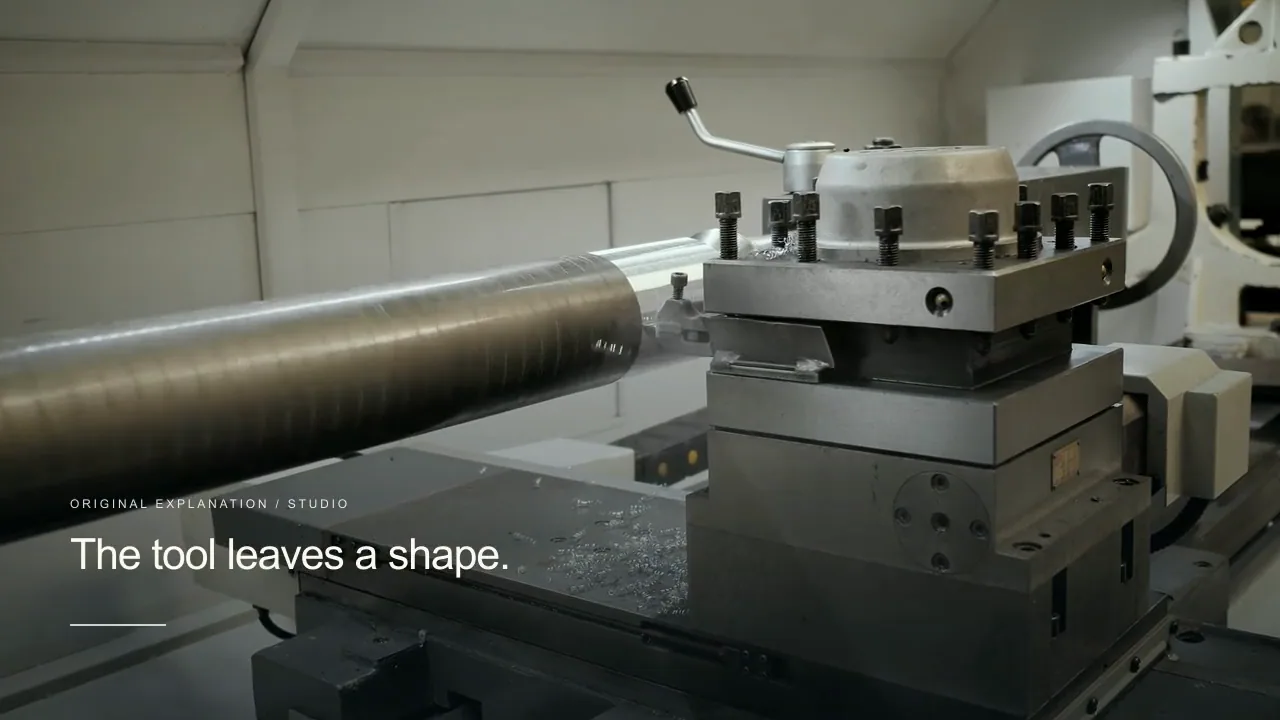
0:00–0:06 — A lathe removes material from a rotating cylinder. On-screen: “The tool leaves a shape.”. Spoken: “A workpiece rotates as the cutting tool contacts its surface.”
0:06–0:12 — An original tool moves along a turning workpiece and reveals its profile. On-screen: “Relative motion. Visible profile.”. Spoken: “The relative motion of tool and material defines the profile.”
0:12–0:18 — A workshop machine cuts steel. On-screen: “Material is being removed.”. Spoken: “Removing material creates a different shape on the workpiece.”
0:18–0:24 — A worker operates an industrial lathe. On-screen: “A real setup needs review.”. Spoken: “The finished feature starts with a reviewed part requirement.”
What the film does and does not establish
The animation is intentionally simplified and not to scale. It does not specify machining parameters, tolerances, feed direction for a real setup, workholding, or safe machine operation.
Keep the business information reviewable
If the part or process changes, revise the highlighted profile, the task description, and the captions together; actual setup instructions remain a separate reviewed deliverable.
Production and source
This is a complete authored studio film with four independently sequenced scenes, original narration, a film-specific score, and captions. The film is a fictional campaign concept rather than a customer case or a Martius product execution recording.
Real stock shots and original simplified illustrations are explicitly distinguished. Raw source footage stays in private production directories; only the edited film, poster, and captions are published.
Words, sound and scene notes
- 00:00
- A workpiece rotates as the cutting tool contacts its surface. [Visual: A lathe removes material from a rotating cylinder. Original instrumental score.]
- 00:06
- The relative motion of tool and material defines the profile. [Visual: An original tool moves along a turning workpiece and reveals its profile. Original instrumental score.]
- 00:12
- Removing material creates a different shape on the workpiece. [Visual: A workshop machine cuts steel. Original instrumental score.]
- 00:18
- The finished feature starts with a reviewed part requirement. [Visual: A worker operates an industrial lathe. Original instrumental score.]