The brief
Explain why the word treatment describes a sequence rather than one visual change. The moving original particles make the stage relationship visible, while real liquid footage supplies physical context.
Scene sequence and accessible transcript
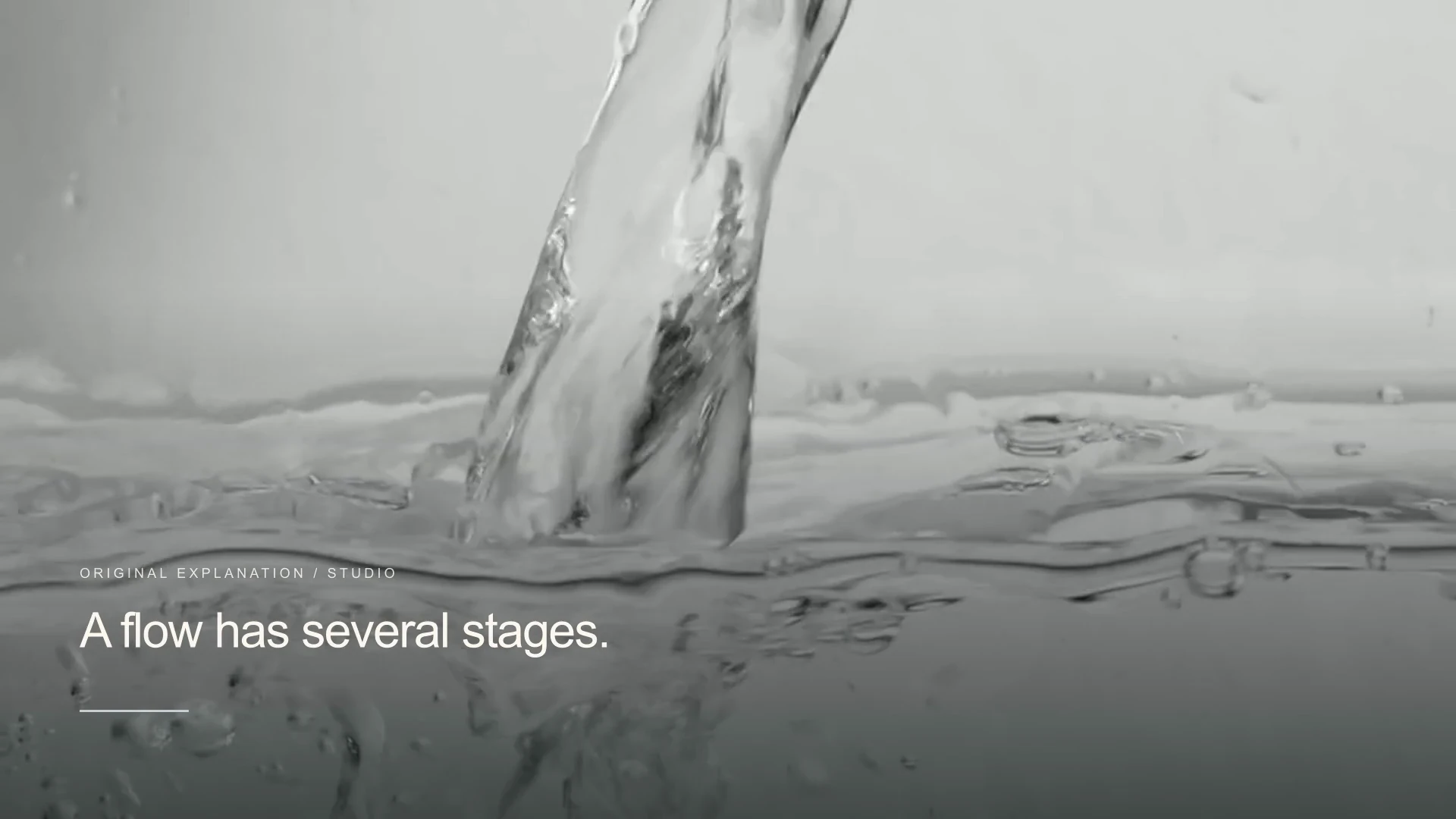
0:00–0:06 — Water fills a transparent container. On-screen: “A flow has several stages.”. Spoken: “A water process contains several stages with different roles.”
0:06–0:12 — Particles move through an original generic staged flow diagram. On-screen: “Follow the stage relationship.”. Spoken: “In this schematic, particles move through successive stages.”
0:12–0:18 — A scientist prepares a sample. On-screen: “Testing is a separate question.”. Spoken: “Sampling connects a process question to a physical sample.”
0:18–0:24 — Real liquid is mixed in a laboratory. On-screen: “Clarity is not proof.”. Spoken: “Visible clarity and tested water quality are different things.”
What the film does and does not establish
This is a generic process illustration, not a plant design or demonstrated treatment result. It does not represent every treatment technology, contaminant, removal efficiency, safe drinking water, or regulatory compliance.
Keep the business information reviewable
Use the actual process stages and reviewed terminology if the film describes a specific facility. Sampling and testing claims must come from real evidence, not the apparent clarity of the picture.
Production and source
This is a complete authored studio film with four independently sequenced scenes, original narration, a film-specific score, and captions. The film is a fictional campaign concept rather than a customer case or a Martius product execution recording.
Real stock shots and original simplified illustrations are explicitly distinguished. Raw source footage stays in private production directories; only the edited film, poster, and captions are published.
Words, sound and scene notes
- 00:00
- A water process contains several stages with different roles. [Visual: Water fills a transparent container. Original instrumental score.]
- 00:06
- In this schematic, particles move through successive stages. [Visual: Particles move through an original generic staged flow diagram. Original instrumental score.]
- 00:12
- Sampling connects a process question to a physical sample. [Visual: A scientist prepares a sample. Original instrumental score.]
- 00:18
- Visible clarity and tested water quality are different things. [Visual: Real liquid is mixed in a laboratory. Original instrumental score.]