The brief
Create a short introduction to the spatial organization of a eukaryotic cell, keeping labels outside the most interesting motion.
Audience: educators, technical communicators and subject specialists creating a concise cell biology film.
The visual approach
00–06s: A real laboratory stock shot shows a researcher preparing a specimen. 06–12s: The film cuts into an original translucent cell model, with varied organelles and curved internal fibres. 12–18s: The nucleus moves into foreground focus. 18–24s: The full cell is shown in one continuous dimensional view.
The warm composition uses a 72 BPM rhythm selected for this storyboard. On-screen words stay short so the cell biology imagery carries the sequence.
Review and editable scope
A real production brief would keep the cell biology subject, source attribution, exact narration and caption wording available for review. A subject specialist must approve the factual explanation before using it in a real lesson.
The studio production plan keeps the four shot selections, crop, title, narration, captions and sound design separate. These notes document how this authored film was made. Use the Martius feature documentation for the product editing and review workflow.
Sources and interpretation
The cell and organelles are hand-authored illustrations, not microscopy, patient material or a faithful scale model.
The linked NIH / NIGMS: cell organelles resource supports the conceptual topic. Stock subjects are illustrative and are not Martius customers, endorsements or evidence of a named facility’s practices. Original illustration is marked as conceptual wherever its appearance could be confused with observed data.
Scene-by-scene transcript
00–06s — A real laboratory stock shot shows a researcher preparing a specimen. On-screen text: A question begins in the lab.. Narration: Cells contain a world of specialized structures. Original stereo score.
06–12s — The film cuts into an original translucent cell model, with varied organelles and curved internal fibres. On-screen text: Many parts. One cell.. Narration: Specialized organelles carry out different cellular tasks. Original stereo score.
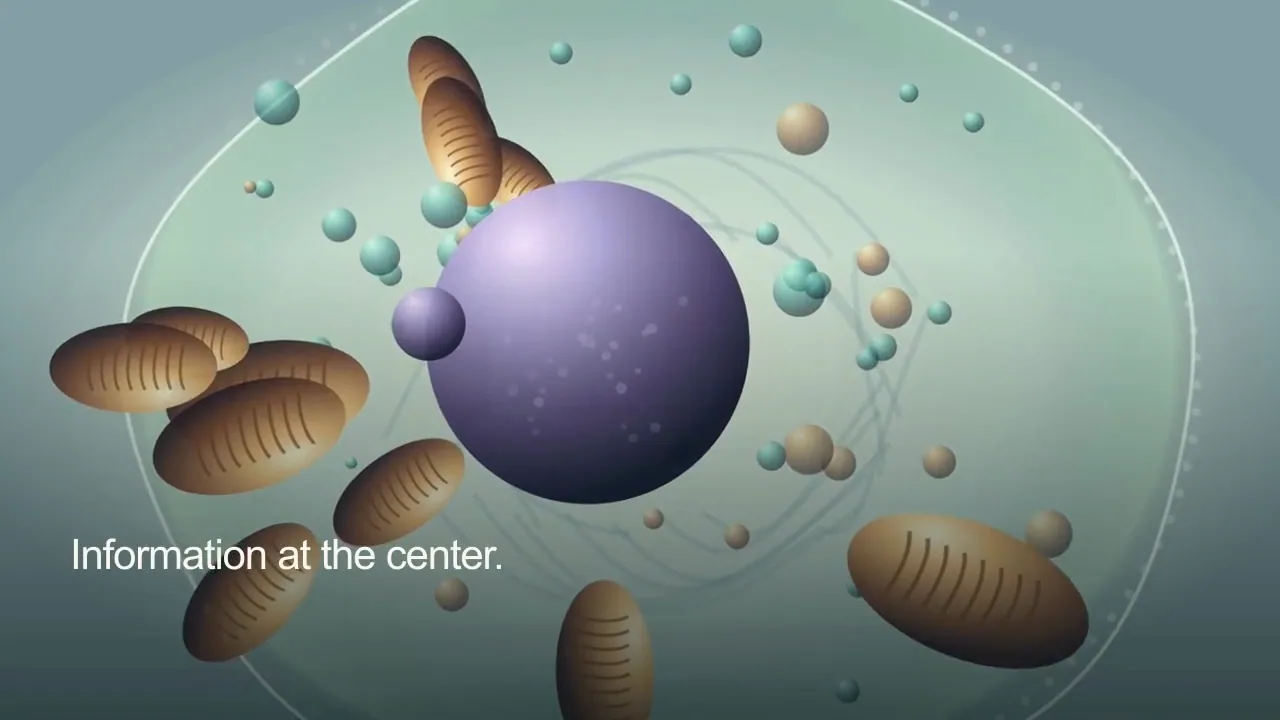
12–18s — The nucleus moves into foreground focus. On-screen text: Information at the center.. Narration: The nucleus contains most of this cell’s genetic material. Original stereo score.
18–24s — The full cell is shown in one continuous dimensional view. On-screen text: Organization makes life possible.. Narration: Structure gives each component a place to work. Original stereo score.
Words, sound and scene notes
- 00:00
- A real laboratory stock shot shows a researcher preparing a specimen. On-screen text: A question begins in the lab.. Narration: Cells contain a world of specialized structures. Original stereo score.
- 00:06
- The film cuts into an original translucent cell model, with varied organelles and curved internal fibres. On-screen text: Many parts. One cell.. Narration: Specialized organelles carry out different cellular tasks. Original stereo score.
- 00:12
- The nucleus moves into foreground focus. On-screen text: Information at the center.. Narration: The nucleus contains most of this cell’s genetic material. Original stereo score.
- 00:18
- The full cell is shown in one continuous dimensional view. On-screen text: Organization makes life possible.. Narration: Structure gives each component a place to work. Original stereo score.