The brief
Teach the double-helix arrangement and base-pair idea with a slow orbit, close dimensional detail and no gene interpretation.
Audience: educators, technical communicators and subject specialists creating a concise genomics and dna film.
The visual approach
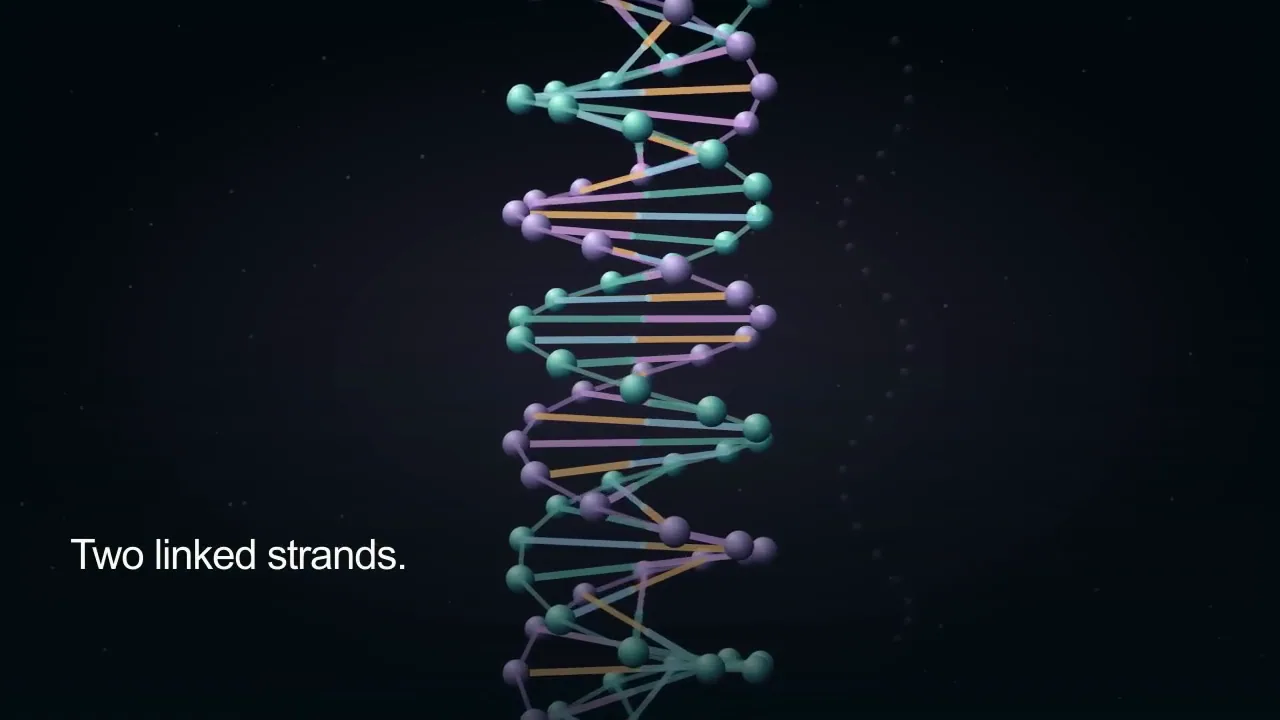
00–06s: A shaded double helix rotates through a deep violet scene. 06–12s: Colored rungs become visible as the camera moves around the backbone. 12–18s: The extended helix opens into a closer view of the ordered rungs. 18–24s: The camera returns to the continuous twisting arrangement.
The science composition uses a 70 BPM rhythm selected for this storyboard. On-screen words stay short so the genomics and dna imagery carries the sequence.
Review and editable scope
A real production brief would keep the genomics and dna subject, source attribution, exact narration and caption wording available for review. A subject specialist must approve the factual explanation before using it in a real lesson.
The studio production plan keeps the four shot selections, crop, title, narration, captions and sound design separate. These notes document how this authored film was made. Use the Martius feature documentation for the product editing and review workflow.
Sources and interpretation
The helix uses stylized molecular beads, arbitrary colors and a fictional short sequence. It is not an atomic model or genetic test result.
The linked NIH / NHGRI: a brief guide to genomics resource supports the conceptual topic. Stock subjects are illustrative and are not Martius customers, endorsements or evidence of a named facility’s practices. Original illustration is marked as conceptual wherever its appearance could be confused with observed data.
Scene-by-scene transcript
00–06s — A shaded double helix rotates through a deep violet scene. On-screen text: Two linked strands.. Narration: DNA has two linked strands in a double helix. Original stereo score.
06–12s — Colored rungs become visible as the camera moves around the backbone. On-screen text: Pairs hold the connection.. Narration: Bases pair across the two strands. Original stereo score.
12–18s — The extended helix opens into a closer view of the ordered rungs. On-screen text: Order carries information.. Narration: Their sequence carries biological information. Original stereo score.
18–24s — The camera returns to the continuous twisting arrangement. On-screen text: A shape with a story.. Narration: Structure makes the idea easier to see. Original stereo score.
Words, sound and scene notes
- 00:00
- A shaded double helix rotates through a deep violet scene. On-screen text: Two linked strands.. Narration: DNA has two linked strands in a double helix. Original stereo score.
- 00:06
- Colored rungs become visible as the camera moves around the backbone. On-screen text: Pairs hold the connection.. Narration: Bases pair across the two strands. Original stereo score.
- 00:12
- The extended helix opens into a closer view of the ordered rungs. On-screen text: Order carries information.. Narration: Their sequence carries biological information. Original stereo score.
- 00:18
- The camera returns to the continuous twisting arrangement. On-screen text: A shape with a story.. Narration: Structure makes the idea easier to see. Original stereo score.