The brief
Use the curved Earth and expanding layers to explain that atmosphere varies with altitude, rather than presenting a list of altitude numbers.
Audience: educators, technical communicators and subject specialists creating a concise earth and atmospheric science film.
The visual approach
00–06s: The curved planet and a thin atmospheric rim emerge. 06–12s: The conceptual camera reveals the closest atmospheric band. 12–18s: Additional atmospheric bands expand above the planet. 18–24s: The camera shows the atmosphere’s extended outer band.
The ambient composition uses a 76 BPM rhythm selected for this storyboard. On-screen words stay short so the earth and atmospheric science imagery carries the sequence.
Review and editable scope
A real production brief would keep the earth and atmospheric science subject, source attribution, exact narration and caption wording available for review. A subject specialist must approve the factual explanation before using it in a real lesson.
The studio production plan keeps the four shot selections, crop, title, narration, captions and sound design separate. These notes document how this authored film was made. Use the Martius feature documentation for the product editing and review workflow.
Sources and interpretation
NASA Goddard Conceptual Image Lab supplied the conceptual atmospheric animation. Layer thickness and orbital camera motion are illustrative, not to scale. NASA does not endorse Martius.
The linked NASA Science: atmospheric layers resource supports the conceptual topic. Stock subjects are illustrative and are not Martius customers, endorsements or evidence of a named facility’s practices. Original illustration is marked as conceptual wherever its appearance could be confused with observed data.
Scene-by-scene transcript
00–06s — The curved planet and a thin atmospheric rim emerge. On-screen text: A world wrapped in gas.. Narration: Earth is surrounded by a layered atmosphere. Original stereo score.
06–12s — The conceptual camera reveals the closest atmospheric band. On-screen text: Weather starts close to home.. Narration: Most weather occurs in the lowest layer. Original stereo score.
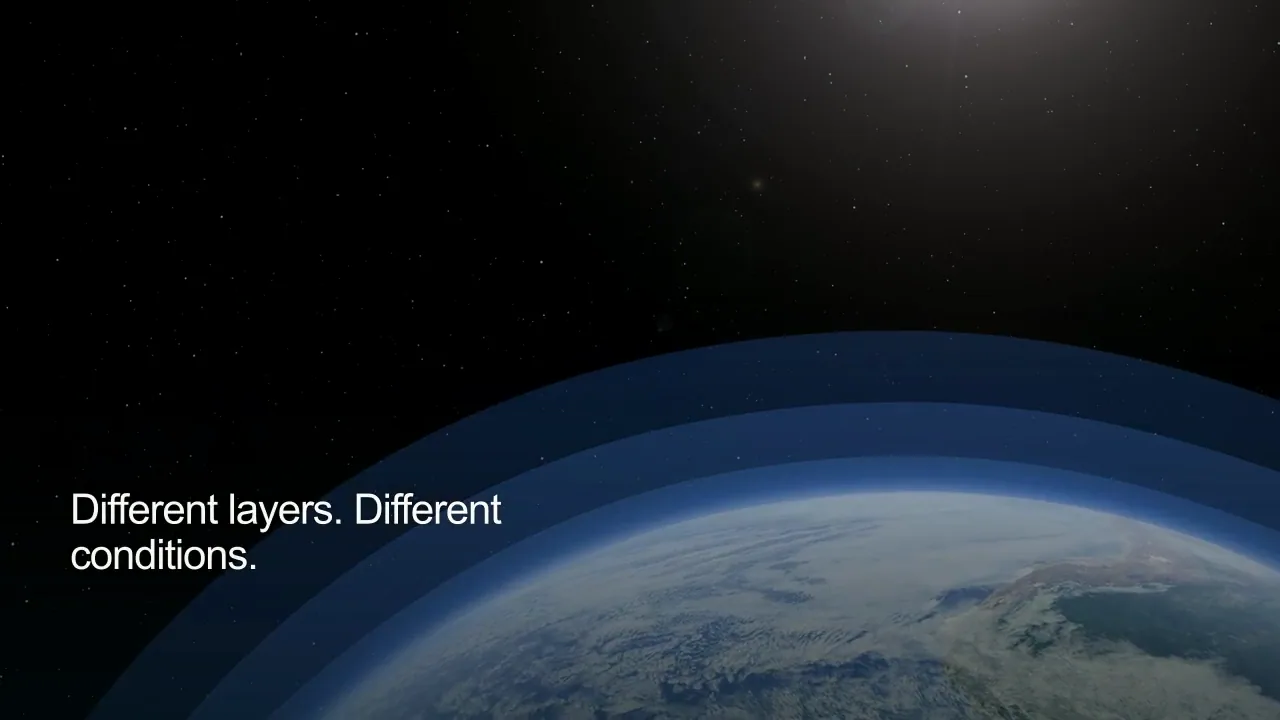
12–18s — Additional atmospheric bands expand above the planet. On-screen text: Different layers. Different conditions.. Narration: Temperature and density change with altitude. Original stereo score.
18–24s — The camera shows the atmosphere’s extended outer band. On-screen text: A gradual edge to space.. Narration: The outer atmosphere gradually thins toward space. Original stereo score.
Words, sound and scene notes
- 00:00
- The curved planet and a thin atmospheric rim emerge. On-screen text: A world wrapped in gas.. Narration: Earth is surrounded by a layered atmosphere. Original stereo score.
- 00:06
- The conceptual camera reveals the closest atmospheric band. On-screen text: Weather starts close to home.. Narration: Most weather occurs in the lowest layer. Original stereo score.
- 00:12
- Additional atmospheric bands expand above the planet. On-screen text: Different layers. Different conditions.. Narration: Temperature and density change with altitude. Original stereo score.
- 00:18
- The camera shows the atmosphere’s extended outer band. On-screen text: A gradual edge to space.. Narration: The outer atmosphere gradually thins toward space. Original stereo score.